Player Dispute Records: Spinny Casino Complaints and Ratings
 Available in GB
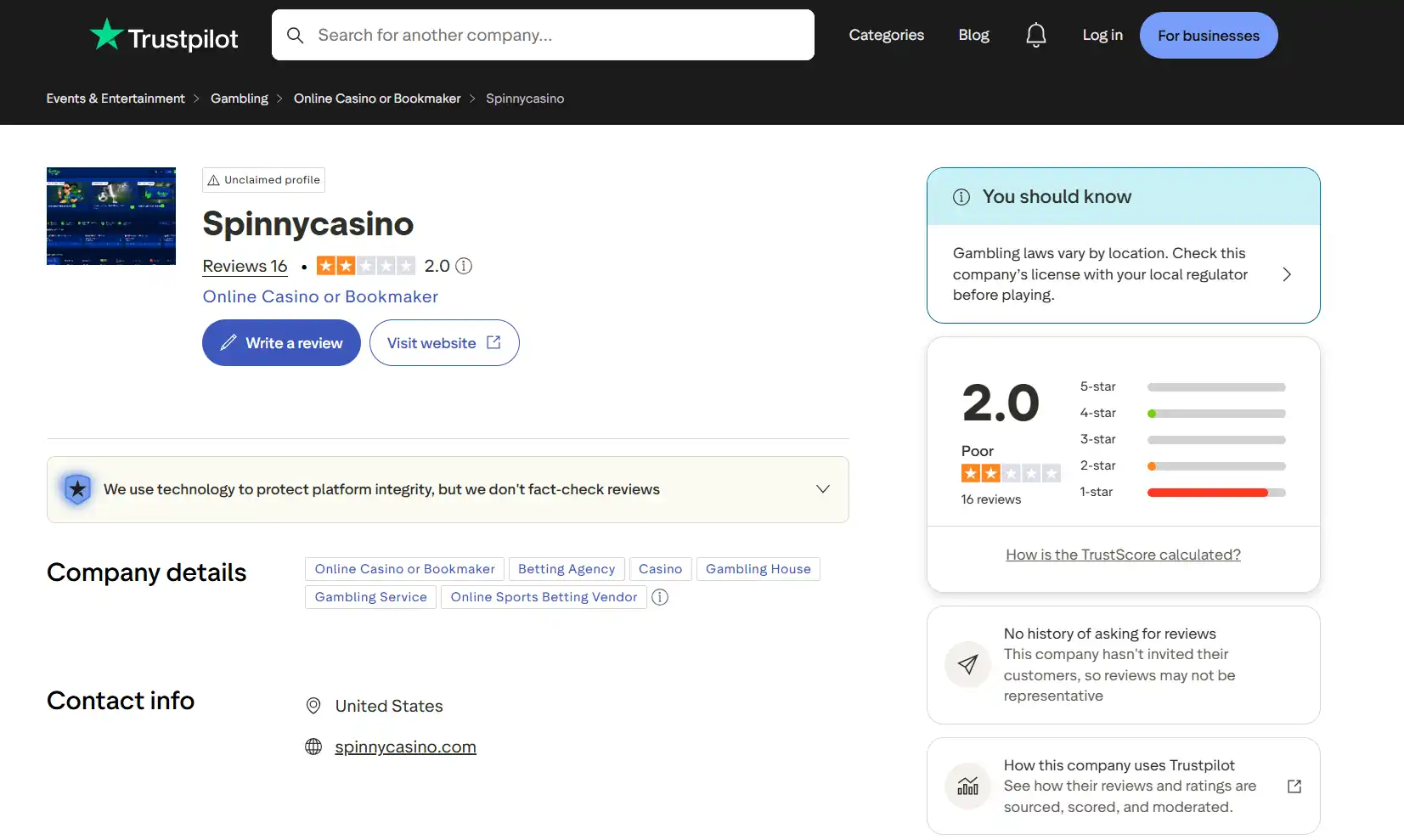
Current third-party feedback on Spinny is strongly negative, but the figures and allegations need careful interpretation. Trustpilot showed Spinnycasino at 2.0/5 from 16 reviews, with 88% of reviewers selecting one star. Casino Guru rated Spinny Casino’s Safety Index at 1.5/10, labelled “Very low”, and its complaint centre includes unresolved cases involving withdrawal, verification and bonus disputes. These figures are reputation signals, not proof that every allegation is true or that every player will have the same experience.
The useful question is not whether one angry review sounds convincing. It is whether several independent sources show recurring themes, how those cases were handled, how large the sample is, and whether an expert complaint mediator records a case as resolved, rejected or unresolved. That method gives UK readers a more defensible way to interpret Spinny complaints than simply repeating labels such as “scam” from individual reviewers.
Table of Contents
- Spinny Casino Player Feedback: Trustpilot Ratings and Complaint Records
- What current Trustpilot reviews say
- What Casino Guru complaints add
- Complaint status matters more than complaint count
- Withdrawal complaints need separate fact checking
- How to weigh the Safety Index against user ratings
- A practical way to assess a Spinny complaint before depositing
- Sample size is a major limitation
- What could change the risk picture
- Review platforms and complaint records consulted
- Why complaint timing matters
Spinny Casino Player Feedback: Trustpilot Ratings and Complaint Records
| Source | What it shows | How to interpret it |
|---|---|---|
| Trustpilot | 2.0/5 from 16 reviews; 88% one-star | A small but heavily negative user-review sample. Individual claims remain allegations. |
| Casino Guru | Safety Index 1.5/10, “Very low” | An editorial assessment produced by Casino Guru, not a regulator finding. |
| Casino Guru complaint centre | Unresolved complaints include withdrawal, verification and bonus-related disputes | More useful than a raw star rating because case status and mediator activity are visible. |
These sources answer different questions. Trustpilot captures customer sentiment. Casino Guru’s Safety Index is an expert editorial rating based on its own methodology. Casino Guru complaints add case-level process information. None of those sources substitutes for a licence register, so readers who want the regulatory position should use our Spinny licence check separately.
What current Trustpilot reviews say
The Trustpilot profile is small: 16 reviews at the time of this check. That means a few additional reviews could move the headline score noticeably. Even so, the distribution is important because it is not merely mixed around the middle. Trustpilot displayed 88% one-star reviews, 6% two-star, no three-star reviews, 6% four-star and no five-star reviews.
The recurring negative themes visible in recent reviews include withdrawals being refused or reduced, repeated requests for verification material, bonus restrictions affecting withdrawable winnings, and dissatisfaction with self-exclusion or account-control processes. A minority signal exists too. One UK reviewer in August 2026 gave four stars and wrote that withdrawals became easy after full verification. That counterexample matters because complaint analysis should not erase positive reports simply because the overall distribution is poor.
Individual Trustpilot posts should not be rewritten as established facts. A reviewer can report what they experienced, but the platform does not independently prove every underlying event. The responsible editorial use is therefore: “a reviewer alleged” or “reviews complained about”, followed by the date and context, rather than stating the allegation as a finding about Spinny itself.
What Casino Guru complaints add
Casino Guru provides a different type of evidence because its complaint centre shows a procedural status and mediator commentary. One UK complaint submitted on 24 April 2026 concerned repeated verification requests and a £329 deduction connected to bonus restrictions after a £1,000 cash-out request. Casino Guru marked the case unresolved on 25 May 2026 after stating that the casino did not respond to its attempts to obtain clarification. The complaint page assigns 56 black points and labels the verdict “No reaction policy”.
That case does not establish that every withdrawal will be delayed or reduced. It does show that a named third-party mediator documented a specific dispute, attempted to engage the casino and closed the case unresolved. This is a stronger reputation signal than an isolated forum post because the process and outcome are recorded, while still remaining separate from a court, regulator or ombudsman decision.
Casino Guru forum discussion also contains user reports about bonus-related withdrawal limits and support guidance. Forum material is useful for discovering recurring themes, but it carries less evidential weight than a formally handled complaint because identity, documentation and chronology can be incomplete. We therefore use forum discussion only as context, not as a basis for categorical claims.
Complaint status matters more than complaint count
Raw complaint totals can mislead. A busy casino may accumulate more complaints simply because it has more customers, and a small casino may show few public disputes because fewer people use it. The more informative signal is how complaints are classified and what happened during mediation.
Resolved
The complainant and casino reached an outcome the mediation platform treated as resolved. This does not necessarily mean every original allegation was wrong or right.
Rejected
The mediator concluded the complaint did not meet its criteria, lacked sufficient evidence, or otherwise should not proceed as a valid case.
Unresolved
The issue was not settled. Reasons can include disagreement, missing evidence or a casino not cooperating with the mediation process.
Open
The process is still active. An open case should not be treated as a final adverse finding.
For Spinny, unresolved cases are the most relevant warning signal because they indicate that at least some disputes reached the end of the third-party process without a satisfactory resolution. Before acting on that evidence, read the individual case summary rather than relying on the status badge alone.
Withdrawal complaints need separate fact checking
Withdrawals are a repeated complaint theme, but user reports should not be used to invent a universal processing time, fee or cash-out limit. Those are high-risk operational details that require current official terms. The current complaint record supports saying that some reviewers and complaint cases describe delayed, reduced or disputed withdrawals. It does not support publishing a single exact waiting time or a universal limit for every account.
For practical payment guidance, including what can and cannot be verified about cashing out, use our Spinny withdrawals. That page separates listed payment facts from exact limits or timings that can change and should be checked in the live cashier and account terms.
How to weigh the Safety Index against user ratings
Casino Guru’s 1.5/10 Safety Index and Trustpilot’s 2.0/5 score both point in a negative direction, but they are not equivalent measures. Trustpilot aggregates individual customer ratings. Casino Guru applies an editorial methodology that includes factors beyond a simple average of public reviews. One is crowd sentiment; the other is an expert score produced by a review publisher.
Agreement between two different types of signal can increase the reason to investigate further, but it still does not transform either score into a legal verdict. A regulator can determine licence status. A court or authorised dispute process can make formal findings within its remit. Review platforms provide reputation information. Keeping those categories separate is central to our broader Spinny safety review.
A practical way to assess a Spinny complaint before depositing
- Check the date. A complaint from years ago may describe terms or processes that have changed.
- Identify the exact issue: bonus terms, KYC, withdrawal, account closure or responsible-gambling controls.
- Look for a response from the casino or mediator rather than reading only the original accusation.
- Check the final status. Resolved, rejected and unresolved cases have different meanings.
- Compare the issue with current official terms if the dispute turns on a numeric limit, wagering rule or document requirement.
- Keep licence status separate from reputation signals. A licence does not erase complaints, and complaints do not by themselves prove licence status.
- Decide your threshold before depositing. If unresolved withdrawal or verification disputes are a deal-breaker for you, that is more useful than trying to predict whether your own case would be different.
Sample size is a major limitation
Sixteen Trustpilot reviews are enough to show that the current sample is overwhelmingly negative, but not enough to estimate an accurate failure rate for all Spinny customers. We do not know the total number of players represented by the review pool, and people with unusually good or bad experiences may be more motivated to post publicly.
That is why the strongest conclusion is limited: current public reputation signals are poor and include unresolved complaint cases. A stronger claim such as “most players cannot withdraw” would require denominator data and independently established outcomes that these sources do not provide.
What could change the risk picture
The reputation picture can change as new reviews, complaint outcomes or regulatory actions appear. A larger Trustpilot sample with a materially different distribution, newly resolved Casino Guru cases, meaningful operator responses or new complaint patterns would all matter. A new regulatory action would be a separate licence and safety signal rather than part of a complaint score.
For readers comparing the whole product rather than only complaints, the full Spinny review brings together games, payments, mobile access, licensing and reputation. The complaint page is intentionally narrower: it shows how to read the current feedback without treating every accusation as proven or every rating as meaningless.
Review platforms and complaint records consulted
- Trustpilot Spinnycasino profile
- Casino Guru Spinny Casino review and Safety Index
- Casino Guru unresolved Spinny complaint submitted 24 April 2026
Why complaint timing matters
A complaint should also be read against the sequence of events. A withdrawal dispute that begins before verification is complete is different from a case where verification was confirmed and a later deduction is disputed. Likewise, a bonus complaint can turn on whether the player accepted promotional terms, whether those terms were visible, and what the mediator could document. Chronology helps separate a general frustration from a specific process failure.
For that reason, we give more weight to dated cases that show the original submission, follow-up requests, casino response or non-response, and final mediator status. A short star review can still be useful as a sentiment signal, but it rarely contains enough evidence to establish the full sequence.
Created by the ”Spinny Casino” editorial team.